For the adults of teenagers.
Your child
is not behind.
Neither are you.
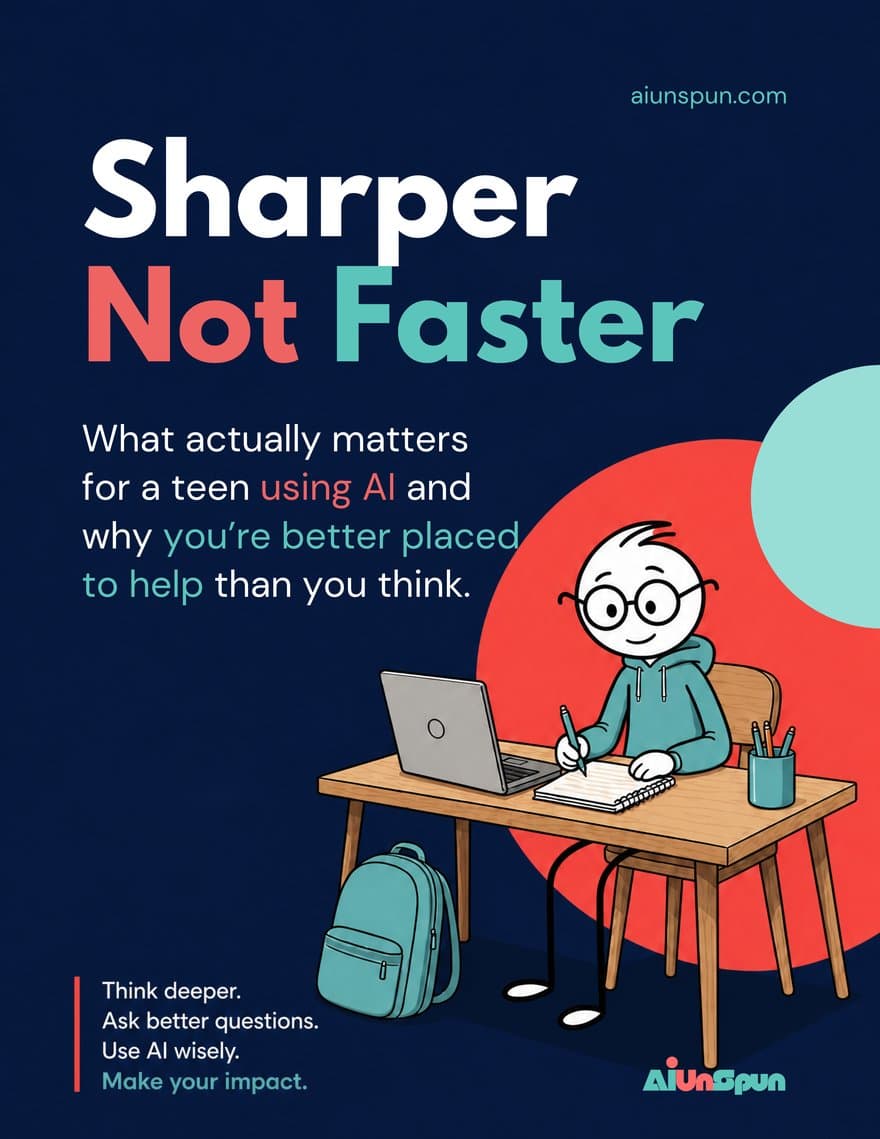
Sharper, Not Faster is a plain-English PDF guide about what actually matters for a teenager using AI, and why you’re better placed to help than you think. Not a book about limits: a book about the difference between the use that keeps them sharp and the use that quietly does their growing for them.
Written with 13 to 16 year olds in mind. No AI experience needed on your side: they teach you the machine, you teach them judgment.
- You Teach Me, I’ll Teach You — fifteen minutes at the kitchen table, and the teenager goes first
- The Three Tests — how anyone can tell whose thinking a piece of work still is
- 8 things worth doing together — a song, a trip, a future to try on, fifteen minutes at a time
- The teen version — three minutes, written for them, sent from your phone. Nothing collected, ever
- 8 printable cards + a companion page that keeps the moving parts current, and dated
Buying it for someone else? It was built for that. Here’s how gifting works.
Real pages from the guide. Have a flip through.— Kevin
Who exactly is selling you this fear?
An entire market runs on “your child will be left behind.” We don’t sell that, because it isn’t true, and because you deserve the actual picture. Here it is, in three moves. The numbers behind each one live on the companion page, with sources and dates.
“Your child will be left behind without this.”
More teenagers use AI than their parents realise, and it is not close. Your child is almost certainly not behind. If anything, they are ahead of the adults worrying about them.
“Every other family is doing something about this.”
You are being priced by other parents’ decisions. Researchers found that telling parents about AI’s costs made them more likely to back a ban in schools, and no less willing to pay for it at home. The fear does not inform the spending. It just seasons it.
“AI is doing their thinking for them.”
Fluency without evaluation: work that reads beautifully that nobody in the house can defend. It is real, it is specific, and it is exactly what the book teaches both of you to notice. That is a skill, not a crisis.
You are not choosing between using AI and falling behind. You are choosing between the use that keeps them sharper and the use that quietly does their growing for them. Same tool, same speed, entirely different consequence. That difference is the whole book.
Before you explain anything, they teach you.
The book opens with an exchange, not a lecture. Round one: the teenager shows you five things. You may not correct, improve, or steer. Not for fifteen minutes.
Round two, five minutes: your turn. One time knowing something caught a mistake the machine made. That’s the trade the whole book runs on: they know the tool, you know things.
The point is not the activity. It’s what it does to the relationship before every other conversation in the book. Nobody is the student here; a fourteen-year-old has judgment, taste and opinions. What they don’t have yet is decades of it, and that part is your job.

You don’t need to know more about AI than they do. That was never the job.
- Show me something stupid AI has done.
- Show me something it’s actually good at.
- What do you use it for?
- What do your friends use it for?
- What’s one thing adults get wrong about it?
How you tell good use from hollow use.
Having AI turn a messy list into a table is sensible delegation; nobody is trying to learn that. Having it write the essay that was meant to teach you to think is not. The book gives both of you the vocabulary for that line:
The rule is not “never let AI do the thinking.” It is “don’t outsource the part you’re supposed to be learning.”
No verdicts, no labels, no software watching anyone. Three questions and a ladder a teenager can place themselves on honestly. The scoring is a gradient, because someone learning something genuinely new often can’t yet spot a sophisticated error, and that’s information, not a failure.
Ask them about any piece of work. Yours or theirs.
The more of these you can answer yes to, the more of the thinking is still yours. If all three are no, that’s a warning sign.
The two-second version, for when three questions is two too many: “Who’s doing the thinking here?”
Not lessons. Fifteen-minute AI experiments.
Eight activities, and an instruction most books wouldn’t dare print: don’t do all of these. Pick the one that actually sounds interesting. Try it for fifteen minutes. Stop if nobody’s enjoying it. Every activity ends with a parent sidebar: what just happened, and why it was the good kind of delegation.
Make a Song
Absurd and specific. The moment to watch for: when they stop asking for a new one and start fixing the one they have.
Plan the Trip
Constraints, verification, negotiation. And if the family takes some version of it, they’ve used AI to change the real world.
Try On a Future
The AI interviews them, proposes experiments, and makes no predictions. Written for the older half of the range, and it says so.
AI vs. Grandma is the sleeper hit: ten questions to the machine and to the family member who knows one thing properly. The expert marks it. It sounds exactly as confident when it knows as when it doesn’t, and everyone in the room learns that at once.
Included: three minutes, written for them.
A guide handed over by a parent has usually lost before it is opened. So the teenager’s piece isn’t a chapter of your book: it’s five full-screen cards on their phone, about forty seconds each, in a voice that’s on their side. It opens by saying so: we’re not going to tell you to use it less; we’re going to show you what the good uses actually look like.
It ends with three things to actually try, and the link comes with your book. The hand-over page tells you the whole move: send it, then leave it alone. No follow-up question, no “did you read it.”
Nothing collected
No account, no sign-up, no email box, no cookies, no analytics of any kind. The moment a teenager hits a form it’s an ad, so there are no forms.
Not a summary of the book
It never mentions that a parent guide exists. Five ideas worth having, written to survive a cynical fifteen-year-old who didn’t ask for it.
Sent from you, not from us
The book’s hand-over page and the companion’s send button put the link in your own messages. We never see who you send it to, because nothing is sent by us.
AI age rules are confusing and keep changing.
We keep track of them for you.
Which tools a teenager may use, at what age, with whose consent: those rules change without notice. This one planned for that. The thinking in print never expires,
and everything that expires lives on one online companion page.
The regular check is run by AI agents and read by humans. Password-protected; the password lives in your copy of the book.
The thinking doesn’t expire. This is the part that updates.
Nobody pays to be recommended here. No affiliate links. The advice has no side.
Plenty of people arrive at this page having decided their teenager is fine and they’re the one who’d like a week with the machine first. That instinct is sound, and it has a home here: start with our beginner’s door and come back whenever you like. This book will keep.
(And nothing in this book requires AI skill on your side. The first activity has the teenager doing the driving on purpose.)
No panic. No predictions. No policing.
And one honest line about what it can promise: the right kind of use stops a teenager losing ground. Nobody can honestly promise you more than that, so we don’t. The book teaches the difference; the difference is what lasts.
One payment. Yours forever.
Pay once. No urgency. Ever.
- The Book. 75 illustrated pages, as a PDF. Download it, print it, keep it forever.
- 8 Activities. Three proper experiences and five quick tries, fifteen minutes at a time.
- The Teen Version. Five cards on a phone, three minutes, written for them. Nothing collected.
- Eight Keeper Cards. Printable, US Letter. The three tests go on the fridge; the exchange card goes in your pocket.
- The Companion Page. Age rules per activity, checked regularly and dated. The password is printed in your book.
- The Gift Page. Printable, for when this is a present. It says "something to try, not something to read."
Instant PDF download · local currency shown at checkout.Payment is handled by Paddle. We never see your card.
Not quite the one?Find the guide you actually need.
Six guides, one job each. Pick the sentence that sounds like you.
Questions, before you decide.
They teach you the machine.
You teach them judgment.
That’s this. Fifteen minutes at the kitchen table, three tests, eight things worth trying, and a three-minute version for them. One payment of $27 USD. Yours to keep.
Local currency shown at checkout.Payment is handled by Paddle. We never see your card.
You’re not really giving
a book. You’re giving a couple of weekends.
Fifteen minutes at the kitchen table, one afternoon making something ridiculous, and a conversation that would probably not otherwise have happened. Which is worth saying out loud, because “I got you a book about AI and teenagers” can sound like a comment on somebody’s parenting, and that is not what this is.
It’s a PDF you own, so gifting is simple: buy a copy, give that copy. One bought copy per household you gift — honour system, and part of what keeps the price sensible.
Something to try, not something to read.
Fifteen minutes, and they go first.
Buy their copy
Use your own email at checkout — the download link arrives in your inbox.
Download the PDF
The whole book, the cards, the teen link and the companion-page password included. No account for them to set up.
Hand it over
Send it or print it — with the gift page on top, so it lands as an invitation rather than a verdict.